Daniel
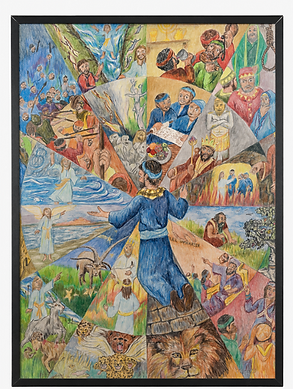
ABOUT THIS DRAWING
Judgment upon the Gentiles
Hope for the Jews
God’s Power and God’s Purpose
One of the things I enjoy doing with these paintings is bringing attention to stories from the Bible that are not always emphasized in Sunday school. Most people already know about Daniel in the lions’ den and his friends in the fiery furnace.
Because Daniel contains twelve chapters, I decided to represent twelve stories around the painting in the form of a clock face. The first six focus mainly on events in Daniel’s life and the lives of those around him. The final six focus more on visions and their interpretations. I placed Daniel in the center so that he could be connected with every section.
First: Daniel and His Friends Remain Faithful
Daniel and his three friends refused to participate in practices that violated their beliefs. They sought to demonstrate that obedience to their God was better than the customs being imposed upon them.
You can see them studying and eating fruit while others drink strong wine and overindulge in food. Their faithfulness began with what might have seemed like a small decision, yet it established the pattern for everything that followed.
Second: Daniel Interprets Nebuchadnezzar’s Dream
King Nebuchadnezzar was deeply troubled by a dream and demanded that the Chaldean magicians, conjurers, wise men, and sorcerers tell him both the dream and its interpretation. He promised gifts, honor, and great reward to anyone who could do so.
When they failed, the king ordered the wise men to be executed, and Daniel was included among them. Daniel requested time, asked his friends to pray, and God revealed the mystery to him.
The dream concerned a great statue representing successive kingdoms: Babylon, Medo-Persia, Greece, Rome, and finally the divine kingdom. Daniel’s interpretation comforted Nebuchadnezzar, led to Daniel’s promotion, and caused the king to confess that Daniel’s God was the God of gods, the Lord of kings, and the revealer of mysteries.
Third: The Fiery Furnace
Daniel asked that Shadrach, Meshach, and Abed-Nego be appointed to positions of responsibility in Babylon.
When Nebuchadnezzar erected a golden image and commanded everyone to bow before it, the three young men refused. Certain Chaldeans reported them to the king, and in his anger he ordered them cast into a blazing furnace.
Nebuchadnezzar asked what god could possibly deliver them. The men who threw them into the furnace died from the heat, yet Shadrach, Meshach, and Abed-Nego remained unharmed.
The king then saw a fourth figure walking with them in the fire, one whose appearance seemed like a son of the gods. Nebuchadnezzar’s hand appears on the right side of the painting, pointing into the furnace. Afterward, he acknowledged their God and promoted the three men in Babylon.
Fourth: Nebuchadnezzar’s Tree Dream
Nebuchadnezzar had another dream that only Daniel, whose Babylonian name was Belteshazzar, could interpret.
The king saw a great and beautiful tree filled with fruit, birds, and animals. Then an angel ordered the tree to be cut down, its branches stripped, its fruit scattered, and the creatures driven away. Only the stump would remain, bound with iron and bronze.
The dream foretold that Nebuchadnezzar would live like an animal, eat grass, and lose his understanding for seven periods of time. This would demonstrate that the Most High rules over humanity and gives power to whomever He chooses.
Daniel urged the king to turn from his sinful ways, but Nebuchadnezzar did not listen. The judgment came upon him and continued until he finally blessed, praised, and honored the Most High.
Fifth: The Writing on the Wall
After Nebuchadnezzar’s death, Belshazzar became king and held a great feast. He ordered that the gold and silver vessels taken from the temple in Jerusalem be brought out so that he, his wives, and his concubines could drink from them.
Suddenly, the fingers of a man’s hand appeared and wrote upon the wall. Belshazzar was terrified and summoned the wise men to read and explain the message.
Once again, they failed. The queen remembered Daniel, and he was brought before the king. Daniel interpreted the writing as God’s judgment upon Belshazzar and the end of his kingdom.
Although Daniel was greatly rewarded, the prophecy was fulfilled that very night. Belshazzar was slain, and Darius the Mede received the kingdom.
Sixth: Daniel in the Lions’ Den
Daniel remained in service under Darius and became so successful that the other commissioners and officials sought a way to discredit him.
Unable to find corruption in Daniel’s conduct, they created a trap involving his faith. They persuaded the king to issue a decree that anyone who prayed to any god or person other than the king would be cast into the lions’ den.
Daniel continued praying to God as he had always done. Although Darius regretted the decree, he was forced to have Daniel thrown into the den.
The king hoped that Daniel’s God would rescue him, and God did. In the morning, Daniel was found alive and unharmed. The men who had accused him were cast into the den, and Darius issued a decree declaring that people throughout his kingdom should fear and honor the God of Daniel.
Seventh: The Four Beasts and the Ancient of Days
The painting now shifts from historical events to Daniel’s visions.
During the reign of Belshazzar, Daniel saw the four winds stirring the sea, and four great beasts emerged.
The first was like a lion with eagle’s wings. The second resembled a bear. The third was like a leopard with four wings and four heads. The fourth was terrifying, with iron teeth and ten horns.
As Daniel watched, a smaller horn appeared, uprooting three of the others. This horn had eyes and spoke boastfully.
Daniel then saw the Ancient of Days seated upon a fiery throne, attended by thousands. The court was assembled, books were opened, and the beast was destroyed.
One like the Son of Man came before the Ancient of Days and received dominion, glory, and an everlasting kingdom. An angel explained that the beasts represented kingdoms that would rise before the final establishment of God’s kingdom.
Eighth: The Ram and the Goat
Daniel later saw himself beside a canal, where a ram with two horns stood. One horn was longer than the other, and the ram charged westward, northward, and southward. No beast could withstand him.
Then a goat came rapidly from the west, seeming not even to touch the ground. It had one prominent horn between its eyes and attacked the ram, shattered its horns, threw it down, and trampled it.
The goat became very powerful, but its great horn was broken and replaced by four others. From one of these emerged another little horn that grew in power toward the south, the east, and the beautiful land.
The vision included attacks against the heavenly host, truth, and the sanctuary. An angel explained that the ram represented Media and Persia, while the goat represented Greece. Daniel was also told that restoration would come after a determined period.
Ninth: Daniel’s Prayer and Gabriel’s Message
Daniel prayed to God and confessed both his own sins and the sins of his people. He pleaded for mercy and asked God to turn His wrath away from Jerusalem.
While Daniel was still praying, Gabriel came to give him understanding. Gabriel told Daniel that he was greatly loved by God.
He explained that Jerusalem would remain desolate for a period of time because of the people’s sins, yet restoration would come. The city and the holy place would be rebuilt, and a determined period would lead toward the coming of the Messiah.
Tenth: The Vision beside the Tigris
During the third year of Cyrus, king of Persia, Daniel was fasting beside the Tigris River.
There he saw a heavenly messenger wearing a belt of gold. The appearance and voice of this figure overwhelmed Daniel, leaving him weak and terrified.
The messenger touched him, strengthened him, and assured him that he was greatly loved. He then explained that he had come to reveal what was written in the book of truth concerning what would happen to Daniel’s people in the latter days.
Eleventh: Future Kings and Conflicts
The next portion contains a detailed account of what the heavenly messenger told Daniel concerning future rulers, kingdoms, wars, alliances, betrayals, and eventual destruction.
Kings would rise and fall. Nations would struggle for power. Agreements would be made and broken. Human rulers would appear strong for a time, yet none of them would escape the limits established by God.
Behind the confusion of earthly history, God’s purpose would continue moving forward.
Twelfth: The Time of the End
The final section looks toward the time of the end.
Daniel is told that many who sleep in the dust of the earth will awaken. Some will rise to everlasting life, while others will rise to shame and everlasting contempt.
Those who have insight will shine brightly, and those who lead many toward righteousness will shine like the stars.
The book that began with captive young men in Babylon ends with resurrection, final judgment, and the everlasting kingdom of God.
Convincing the Gentiles of God’s power.
Convincing the Jews of God’s purpose.
Judgment upon the Gentiles.
Hope for the Jews.