Isaiah
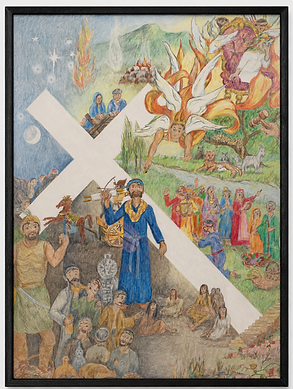
ABOUT THIS DRAWING
Judgment Is Coming
Glory will Follow
Because the people no longer truly knew their God, He gave Isaiah a vision so they would understand that judgment was coming.
God revealed their evil, the consequences of their rebellion, and the punishment that would follow. Yet Isaiah also spoke of hope: the promised child Immanuel, born from the house of David, and the grace Christians understand to be offered through Christ to all who trust in Him.
I divided this painting diagonally from the upper left to the lower right.
The lower-left section is dark and filled with images of night and judgment. There is a partial moon, people hiding among the rocks, Philistines conquering, horses and chariots raiding, idols, worthless offerings, strong drink, gluttonous feasts, and the women of Judah sitting upon the ground in sackcloth. You can also see rotting reeds, fire, vines growing over broken bricks from a fallen wall, and briars and thorns.
These images represent rebellion, chastisement, and the judgments proclaimed against Babylon, Philistia, Moab, Damascus, Samaria, Ethiopia, Egypt, Edom, Arabia, Jerusalem, and Tyre.
Between the two sections, I placed a cross.
In Isaiah 53, the prophet writes of the suffering servant of God. Christians have long understood this passage as pointing forward to Jesus Christ. Isaiah describes a servant who would be afflicted and accused, yet remain silent like a lamb being led to slaughter.
Isaiah also told King Hezekiah to put his house in order because he was going to die. Hezekiah prayed, asking the Lord to remember his faithfulness. God heard his prayer and sent Isaiah back to tell him that fifteen years would be added to his life.
As a sign, the shadow on the stairway of Ahaz moved backward ten steps. We may not receive a sign like Hezekiah’s when we pray during illness. Yet when God assures us through His Spirit that our sins are forgiven and that, whether we live or die, we belong to Him, our prayers have not been in vain.
The upper-right section contrasts sharply with the darkness below. It is lighter, brighter, and more colorful.
Isaiah saw the Lord seated upon His throne. Above Him stood seraphim, each with six wings. With two wings they covered their faces, with two they covered their feet, and with two they flew. One of them carried a burning coal from the altar and touched Isaiah’s mouth with it.
Isaiah was afraid and cried out that he was ruined because he was a man of unclean lips living among a people of unclean lips, and yet his eyes had seen the King, the Lord of hosts. The burning coal represented his cleansing and preparation to speak God’s message.
Isaiah warned the people about what was coming, but he also reminded them of what God had already done. In the painting, you can find Zion, the altars of true worship, Israel’s deliverance from Egypt, the pillars of cloud and fire, and the future deliverance associated with the birth of Christ.
The people prayed for God’s mercy.
Near the end of Isaiah, the blessings of serving God are contrasted with the consequences of rebellion. The people of God are pictured rejoicing, and creation itself is described as being brought into peace: the wolf and the lamb feeding together and the lion eating straw like the ox.
God promises peace to Jerusalem like a river. He pours water upon thirsty land and streams upon dry ground. He pours out His Spirit upon His people and His blessing upon their descendants, causing them to spring up like trees beside flowing water.
Judgment is coming.
Glory will follow.