Jeremiah
ABOUT THIS DRAWING
Preaching Judgment
Hope Amidst Judgment
Portrayal and Prophecy of Judgment
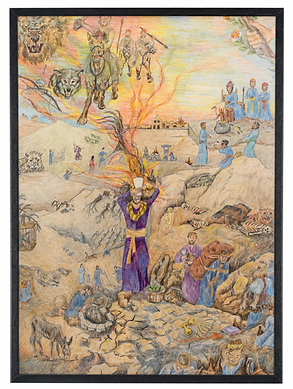
The cup of the wrath of God stands at the center of this painting.
Part of Jeremiah’s call to prophesy came when the word of the Lord asked him what he saw, and he saw the branch of an almond tree. I have placed that branch in the upper right-hand corner. It represented the tree that hastens to awaken from winter sleep. Time was running out. The people needed to repent, or judgment would come.
God warned that serpents would be sent against the people, and I have shown one in the rocks at the middle right. The people had been wounded by their own rebellion, and if they died of those wounds, their blood would be on their own heads. Corpses would lie unburied across the land.
God described His own people as if they had turned against Him like wild creatures. So I included the vulture and the hyena picking over bones on the right side of the painting, showing both the violence of judgment and the desolation that would follow.
The ruined linen sash appears just below and to the right of Jeremiah’s raised hand. God had once said that Israel had been like a fine linen waistband close to Him, but through idolatry and corruption they had become ruined and useless, like a garment buried in foreign earth and spoiled beyond repair.
Because of the people’s sins, God would release His cup of wrath, and that judgment would include drought. My starving donkey appears in the lower left corner, representing the devastation that would come when even creatures accustomed to the wilderness could find neither food nor water.
Among the sins of the people was the worship of Baal, including the burning of their sons as offerings. That scene is drawn near the center above Jeremiah’s hand pointing upward. Above it is the city in flames, burned by the Chaldeans.
At Jeremiah’s feet are two baskets of figs. They represent the exiles. The good figs stand for those who, though carried away to Babylon, still have hearts inclined toward God. The rotten figs represent Zedekiah, his leaders, and the unrepentant people who refused to turn back.
In Jeremiah’s hand is the cup filled with the wine of God’s wrath, rising with flames. The judgment is shown coming down from the north. Drunkards appear in the lower portion of the painting, echoing the image of the nations being made to drink and fall under judgment.
The yoke at Jeremiah’s feet represents submission to Nebuchadnezzar, king of Babylon. God told Jeremiah to make and wear a yoke as a sign that Babylon’s rise was part of His plan. Yet God also promised that one day He would break that yoke and His people would no longer serve strangers.
Near the lower right, among the drunkards, are vessels and treasures representing the sacred objects from the house of the Lord, and also symbolizing the people themselves. God promised that the vessels and the exiles would one day return. The tiny woman playing a tambourine below the charging horse’s front foot points to that future restoration. It looks small now, but it will come. Nearby are the small figures of the returning remnant: the blind, the lame, the pregnant woman, and those in labor, gathered from the north and from far away.
To give the people an opportunity to repent, God told Jeremiah to make a scroll and write down all the words spoken against Israel, Judah, and the nations. Baruch wrote what Jeremiah dictated and then read it aloud. Later the king had the scroll read to him and burned. That event appears in the upper right portion of the painting. Jeremiah and Baruch then made a new copy, and Baruch is shown in purple in the lower right holding it.
The small Egyptian pillars on the left horizon remind us that God can find His people wherever they are. The Spirit of prophecy was not confined to the land of Israel. The pillars point both to history and to what lies ahead.
The tree stumps at Jeremiah’s right elbow represent the cutting down of the people like a forest. However thick the forest, the army of the Chaldeans would be more numerous still. They would come to plunder and destroy.
Zedekiah turned away from the Lord and did evil. After the slaughter of his sons, the conquering Chaldeans put out his eyes and took him away to prison, where he remained until his death.
And yet even in a book so full of warnings, there is hope. Jeremiah speaks not only of wrath, exile, and ruin, but also of return, rebuilding, and restoration. That is why this painting holds both judgment and promise at the same time.
I am sure I have forgotten some details that came to mind while reading Isaiah and Jeremiah. There is so much in these books that it is difficult both to draw it all and later to remember everything I included.